SIRATYST (Stuff I Read and Thought You Should Too) --
“To ravage, to slaughter, to usurp under false titles, they call empire; and where they make a desert, they call it peace.”
(Calgacus, as quoted by Tacitus, Agricola 30-31)"
"If Biden has, in fact, received so
many more votes, why is the CNN-led media flock in such a hurry to
declare him the winner? Is it the media’s job to decide the winner in a
democracy? How will Trump and his sympathisers, about half of the people, react to what they must see as a provocation?
Why is Biden also offering no hope for the US itself and the world? How to explain this utterly strange happening and where will the US be in January 2021?
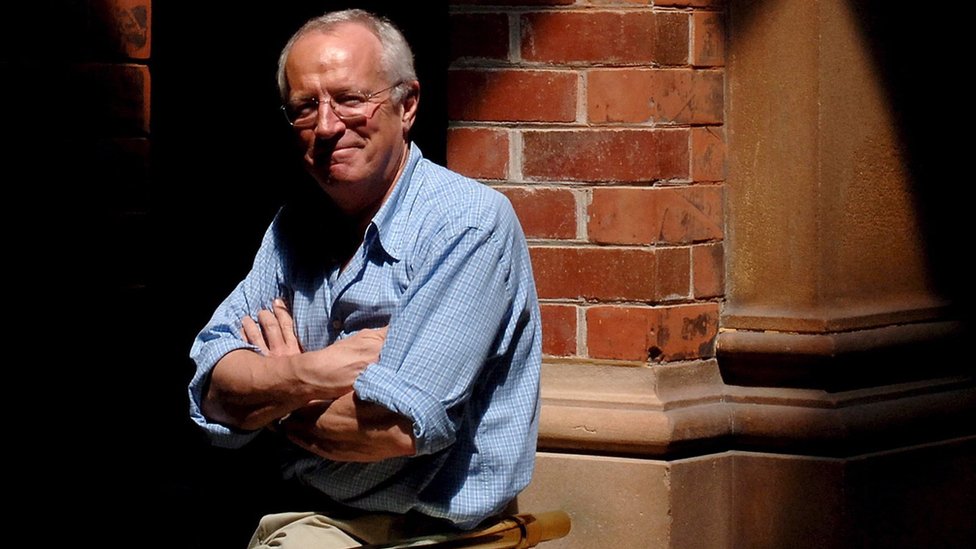
Robert Fisk was best known for his coverage of the Middle East, where he began reporting from in the 1970s
Veteran foreign correspondent Robert Fisk has died of a suspected stroke at the age of 74.
He
had been admitted to St Vincent's Hospital in Dublin after falling ill
at his home on Friday, and died shortly afterwards, the Irish Times
reported.
Fisk won numerous awards for his reporting on the Middle East, starting from the 1970s.
But he also drew controversy for his sharp criticism of the US and Israel, and of Western foreign policy.
Covering wars in the Balkans, Middle East and North Africa for UK newspapers over five decades, Fisk was described by the New York Times, in 2005, as "probably the most famous foreign correspondent in Britain".
Born in Maidstone, Kent in 1946, he later took Irish citizenship and had a home in Dalkey outside the capital Dublin.
Irish President Michael D Higgins has expressed his "great sadness" about Fisk's death on Sunday.
"With his passing the world of journalism and informed commentary on the Middle East has lost one of its finest commentators," he said in a statement.
After
starting his career at the Sunday Express, Fisk moved to Belfast in
1972 to cover the Troubles as Northern Ireland correspondent for the
Times. He became the paper's Middle East correspondent in 1976.
Based
in Beirut, he reported on the civil war in Lebanon, as well as the
Iranian Revolution in 1979, the Soviet war in Afghanistan and the
Iran-Iraq War.
He
resigned from the Times in 1989 after a dispute with the owner Rupert
Murdoch and moved to the Independent, where he worked for the remainder
of his career.
In
the 1990s he interviewed Osama Bin Laden three times for the paper. He
described him as a "shy man" and looking "every inch the mountain
warrior of mujahedin legend" in their first interview in 1993.
'Gutsy and admired'
Robert
Fisk was brave and controversial. He was a brilliant writer, who did
his best work in wars, transporting readers to his side in some burning
village. He relished making enemies, especially if they defended US or
Israeli activities in the Middle East.
Fisk
could be obsessive. He collected bits of shrapnel, often American made
and fired by Israel, so he could use serial numbers to trace their
origins.
When
I visited Beirut from Jerusalem in the 1990s he served me gin and
tonics on his balcony overlooking the Mediterranean in a Yasser Arafat
souvenir glass. Robert was old school. He poked fun at the flak jacket I
brought to Lebanon from the former Yugoslavia, sniffing it to check for
slivovitza plum brandy.
Journalism
can be a dog-eat-dog trade. Fisk's colleagues were not always kind
about his work. I was an admirer, eating up his vivid reportage from
Beirut when I was at school, and was awestruck when first I met him.
I'll miss Robert, his guts and his appetite for the fight, even though
usually he followed a warm hello with some crack about the evils of
television news or the BBC.
After
the 11 September attacks plotted by Bin Laden, Fisk, an Arabic speaker,
spent the next two decades covering conflicts throughout the Middle
East, including in Afghanistan, Iraq and Syria.
He
was highly regarded for his knowledge of, and deep experience in, the
region, and often dismissed journalists who sat behind desks instead of
venturing out into the field.
But
he also drew criticism for his attacks on Western policy in the Middle
East and was accused of being lenient towards the Syrian government in
his reporting of the country's long and brutal civil war.
Articles
by Fisk about the US and Israel were often considered highly
controversial. He said the Trump administration's acceptance in 2019 of
Israel's annexation of the occupied Syrian Golan Heights showed Israel had effectively annexed the US, and repeatedly accused Israel of committing war crimes against the Palestinians.
In 2011 Fisk was forced to apologise
after the Independent was successfully sued by the then-Saudi interior
minister over a report that alleged the minister had ordered police to
shoot and kill unarmed protesters, based on a document which turned out
to be fake.
Fisk married US journalist Lara Marlowe in 1994 but the pair divorced in 2006. He had no children.
The good news is that this can be done while at the same time
accomplishing our goals of ending poverty and improving human
well-being. Indeed, this is the core principle of degrowth. Recent
research has found that we can ensure good lives for all – for a global
population of 10 billion people by 2050 – with 60 per cent less energy than we presently use. Another study found that high-income nations could cut their material use by up to 80 per cent, while still providing for everyone’s needs at a high standard.
How do we get there? Scale down ecologically destructive and socially
less necessary production (SUVs, McMansions, industrial beef, food
waste, planned obsolescence, advertising, etc); shorten the working week
and introduce a public job guarantee, with a living wage, to maintain
full employment and mobilize labour for the transition; decommodify
public goods, disaccumulate capital, and distribute income more fairly.
All of these policies have significant public support. I describe
feasible pathways toward this end in Chapter 5 of Less is More (or see here for
a post-Keynesian approach). Doing this would enable us to accomplish a
rapid transition to renewables, in a matter of years, not decades.
In other words, we cannot reverse ecological breakdown while at the same time pursuing growth; but we can reverse
ecological breakdown while at the same time ensuring flourishing lives
for all. That’s the story we need to be telling. That is where hope
lies.
This week, people are planning protests across the nation beginning
the day after the election. Some, like Democratic Party-aligned groups
and unions, will only demonstrate if President Trump loses and refuses
to leave office. Trump will fail if he tries because the ruling class
has clearly shifted its support to Biden. Professor Adrienne Pine explains this in her analysis of the opposition to Trump. Others such as issues-based groups, coalitions and community groups are planning to take the streets no matter what the outcome of the election is.
This is good news because a mass mobilization of left and progressive
groups is needed to change the rightward direction in which the United
States is headed. Michael J. Smith’s explanation
of the “ratchet effect” describes the roles both Republicans and
Democrats have played in moving our politics in that direction since
1968. In a nutshell, each time the Republicans moved to the right, the
Democrats followed with the excuse that it’s necessary to win votes.
This locks in the rightward motion, opening space for Republicans to
move to the rightward again.
But Smith also writes, “the Democratic Party has assumed the
role of ensuring that the countervailing pressure from the Left doesn’t
happen. The party contains and neutralizes the Left, or what there is of
it. Left voters are supposed to support the Democrat, come what may.”
This is one of the reasons why the expression “the Democratic Party is
the graveyard of social movements” exists. How do we counteract that?
In a recent episode of Eleanor Goldfield’s series, Deception 2020, she and Eugene Puryear discuss
why the trope of “this is the most important election ever” is recycled
in every presidential election. It serves as a great distractor that
puts the focus on personalities rather than the broader social context
of where we are. It pits Republican and Democratic voters against each
other while the ruling class plays both sides, putting the most money on
the one that has the best chance of winning. The people hold their
noses and vote for whomever they consider to be the lesser evil while
the wealthy class knows their interests will be served no matter who
wins.
The year 2020 has brought into clear focus that we are living in a
failed state and can’t afford to be drawn into this distraction. The
number of new COVID-19 cases surpassed 100,000 in one day. The recession
is likely to deepen into a prolonged depression due to Congress’
failure to provide supports for families and their businesses and farms.
The climate crisis is raging. And structural racist violence goes on in
all of its forms while the Pentagon continues its insatiable
consumption of the federal budget leaving austerity for the rest of us
Instead of being caught up in this “political ping pong”, as Kevin
Zeese would call it, we need to focus on these grave issues before us. I
learned some lessons to avoid this ping pong during my involvement with
the health reform process in 2009-10 when we were advocating for
national improved Medicare for all while the Democrats were pushing
their version of a healthcare bill that protected the profits of the
health insurers, pharmaceutical companies and big businesses.
The lesson is best summarized using the acronym “ICU.” Think of it as
what is needed, especially in a time of crisis. The “I” stands for
independent. It is important not to tie our issue to the agenda of a
political party but to maintain independence from them while we press
for what we need, lest our struggle be co-opted. The “C” stands for
clarity, meaning we must be clear about what we are demanding. Members
of the corporate duopoly will always try to water our demands down with
proposals that may sound positive but are less than what we need. Look
at the Democrat’s Green New Deal as a current example that protects the
dirty energy industries and is too little, too late. And the “U” stands
for uncompromising. The ruling class will always tell us we are asking
for too much but we can’t compromise on fundamentals such as health
care, housing, education, financial security and an end to violence
against us. These are universal basic needs that nobody should be
denied.
With this 2020 vision, we can mobilize a broad movement that puts
forth a bold agenda of what we need and fights for it, no matter who is
elected. This is how we reverse the ratchet effect. We can look to Chile
as a recent example of a people succeeding in their struggle to reverse
the ravages of neoliberalism. Patricio Zamorano describes
how a similar situation to what we face, great inequality and
injustice, drove people to mobilize despite severe repression and win
the right to remake their Constitution.
Jeff Bachner/New York Daily News.
Violence on the rise
One reality we must prepare for is the continued rise in right wing
violence no matter who wins the election. If Trump wins and people
continue to struggle to end the injustices we face, right wing
extremists will be emboldened by a president who encourages them. If
Biden wins, they will be angered at what they view as a threat to the
gains they have made and may lash out.
In light of this, communities need to organize to be vigilant to what
is happening around them and to be proactive in creating structures
that provide safety and mutual aid, particularly for those who are most
vulnerable.
We live in an era of great polarization.
This is expected because it goes hand in hand with great inequality and
it often precedes moments of social transformation. Think of it as
heightening the contradictions and forcing a choice. Who are we and how
do we want our society to be?
George Lakey puts the polarization
into historical context. Almost one hundred years ago, when extreme
polarization existed in Europe, some countries moved to fascist
dictatorships while others moved to socialized democracies. The
difference was how the people organized and mobilized. Lakey suggests a
road map.
If people who consider themselves left or progressive fail to
organize and mobilize, we may go the way of a fascist dictatorship no
matter who wins this presidential election. If Trump wins, he may do
what others have done by trying to further consolidate his power into an
authoritarian state. If Biden wins, and he continues the neoliberal and
repressive policies that have marked his 47 years in elected office,
then the conditions will be created in 2024 or beyond for another
Democratic Party loss and an opening for a right wing leader who is more
effective than Trump at consolidating power.
Either way we must mobilize and protect our rights. While most of our
organizing will take place outside the electoral system because that is
where we have power, it will also be necessary to focus on preserving
whatever democratic rights exist and strengthening them.
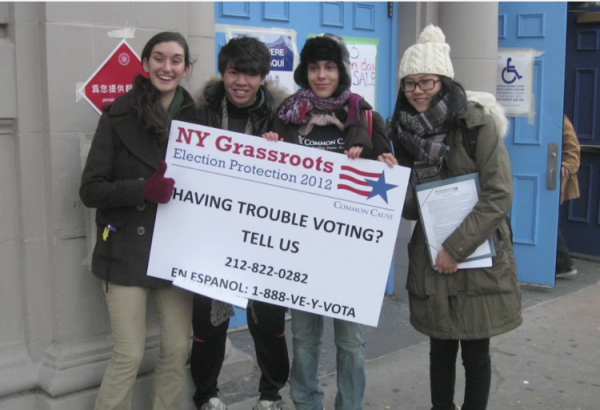
Common Cause NY.
Protecting and improving the election process
As flawed as the electoral process in the United States is, it is the
system we currently have. Fair election and third party activists have
been working to change it for decades. Now, as it is on so many issues,
the major problems with that system – voter suppression, lack of
transparency and the process for choosing a president – are more
evident.
While the United States has never been a democracy, in fact a look at
the founding of the country shows the ruling class who wrote the
Constitution were afraid of it, the people believe in democracy.
Focusing on democratic rights in this election will bring people
together and build momentum to change the system.
Focusing on what President Trump says is a distraction. Recall that Trump was also saying that
he would not commit to accepting the outcome in the lead up to the 2016
election. The Democrats and the groups aligned with them are amplifying
fears to drive voter turn out, and it seems to be working. The latest Gallup Poll finds
almost 70% of registered voters are enthusiastic about the election,
which is an increase from the 50% who were enthusiastic in 2016 and
similar to 2008 levels. This is highest among registered Democrats.
Five Thirty Eight predicts
that due to the electoral process in a few states, for example
Pennsylvania is not allowed to start counting mail-in ballots until
Tuesday, and the way the states are looking right now, neither of the
major party candidates could reach the required 270 electoral votes on
election night. It could take a few days.
This is not cause for panic. Instead, let’s take a collective deep
breath and watch for problems with the process in our states.
Documenting these can be used to challenge and improve the process for
the next round. Already, people have been challenging the election process with more than 300 lawsuits filed in 44 states.
There is a small chance that President Trump will be re-elected. If
that happens, it will be critical to respect that result. To reject an
outcome of the election process we have opens the door to a breakdown of
that system and a vacuum that could threaten the hope of building more
democratic structures.
Remember, no matter what happens on November 3, our struggle goes on.
It is a long term struggle against deeply entrenched structures of
racism, capitalism, colonialism and imperialism that will have successes
and failures. Our best chance for a better future is to keep our eye on
the world we hope to create and keep working toward that goal.
PressTV’s
motto is to give “voice to the voiceless” and so we have given priority
to non-mainstream political groups during our coverage of the US
presidential election. We have spoken with socialists, Greens,
Libertarians and more, but the Democratic Socialists of America -
perhaps best exemplified by failed presidential candidate Bernie Sanders
- has openly blacklisted Iranian media.
After repeated requests, the Chicago chapter of DSA wrote to Press TV
that, “The officers of our organization have decided that it would not
serve our interests to do an interview.”
This caused PressTV management to contact DSA’s headquarters in New
York City to confirm if this allegedly-leftist political group was
really enforcing a blacklist on the entire media of an
internationally-recognized nation. As expected, no response was given,
so - crucially - no denial either.
It is a disheartening policy for a group which openly promises that -
if elected in greater numbers - their members will push the Democratic
Party and thus the entire nation to an unprecedentedly progressive left.
Take, for example, their most prominent member, Representative
Alexandria Ocasio-Cortez. She said as recently as September, "I think,
overall, we can likely push Vice-President Biden in a more progressive
direction across policy issues. I think foreign policy is an enormous
area where we can improve; immigration is another one.”
That begs obvious questions: How can DSA officials from the national
down to the local level make US foreign policy more progressive if they
refuse to talk to foreigners and their representatives? Should DSA
members get elected or be appointed to public office, their members are
willfully ignorant of foreign viewpoints.
Just as worrying regarding the quality of the public service they
will provide, DSA cadres are being trained to use a unilateral approach
when dealing with non-Americans. Lastly, how authentic and patriotic is
DSA if they are not reflecting the values which the average American
seems to champion, such as the freedom of the press?
While Americans are days away from voting in their election, Iran’s next presidential election is in June.
It appears critical for Iranian voters to consider that if DSA - the
allegedly-leftist wing of the Democratic Party - refuses to engage in
normal cooperation with friendly Iranian media, then what is the
likelihood that such people are going to truly push Washington’s Iran
policy in a more open and progressive direction?
So even if Democrats win next week, DSA’s blacklist raises the
question: How could a Joe Biden presidency drastically alleviate the
US-led sanction war on Iran?
The Democratic Socialists of America should immediately reform their
wrongly-guided decision to blacklist Iranian media. Refusal to do so
would be an extremely belligerent policy which only helps to lay the
groundwork for ignorance, murderous sanctions, war and
anti-internationalism, and by a group which claims to be "Democratic"
and “Socialist.”
Press TV’s website can also be accessed at the following alternate addresses:
Two Saturdays ago, a theater company near me presented
a reading of the play, “My Name Is Rachel Corrie,” with four young
women speaking Rachel’s words on a simple stage 50 feet from commuter
rails.
About 60 people were in the audience, and there was none of the
political drama that accompanied the play’s New York premiere in 2006.
Israel’s friends did not succeed in shutting down a progressive theater company‘s
production of the show… When the show did get staged, no one handed out
flyers outside the theater.with pictures of Israeli girls killed in
suicide bombings
Yet in a way the play had more raw power last Saturday night than it
did when I first saw it 14 years ago. Director Christine Bokhour chose
the work because she was looking for a piece that would tie into Black
Lives Matter and other protests. “[Rachel Corrie’s] passion for social
activism, and willingness to put her own life on the line for it, is
what is inspiring to me,” Bokhour wrote in the program. “I cannot
imagine a time when I would have had the courage to do what she did.”
For anyone who doesn’t know: Corrie was an Olympia, WA, writer who
died at 23 in 2003 in Rafah, Gaza, as a volunteer for the International
Solidarity Movement, when an Israeli bulldozer crushed her as she was
trying to protect a Palestinian home from demolition.
Her words are familiar to me. Her published journals, letters and
poems helped propel me into this work in the first place. I can see her
book on my shelf as I am working now: “Let Me Stand Alone“.
But Rachel Corrie’s words were new to my wife and two friends in the
audience that night. And at the end of the show they all sat quietly
with their eyes on the ground. My friends were both too upset to talk
that night, so I caught up with them later.
Each said the play’s power lay in the fact that we get to reimagine the conflict through an young American’s idealistic eyes.
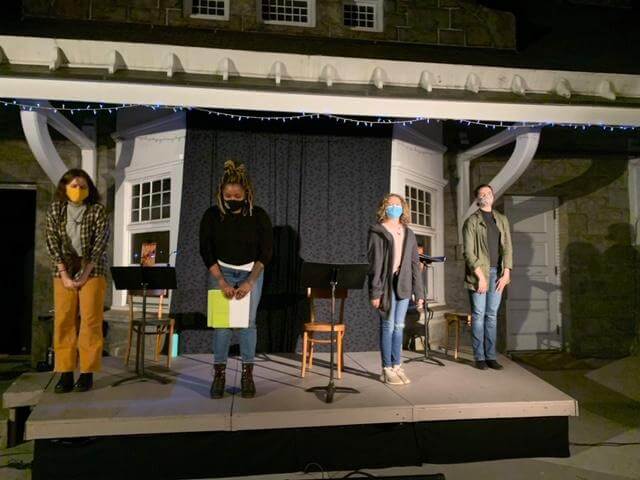
Reading of “My Name Is Rachel Corrie.” Four players are (l to r) Freya Wood-Gallagher, Faith Jones, Phoebe Bokhour and Tess Dul. Photo Courtesy Philipstown Depot Theatre, Garrison, N.Y.
“It resonated in a small town way,” said Sheila Rauch. “The
seriousness of what she was doing came through because of the four small
town girls on the stage. I thought, Rachel Corrie could have been just
like them. No, not every person is as socially conscious as Rachel
Corrie was. But all those girls were relating to her.”
Rauch went on, “All the things you have heard before about this
conflict — they were in the play, but through the eyes of someone so
young, so unprotected, and so American, whose whole understanding is
American. When she said, I’m so pathetic, how can I be the best hope for
these people who are being so hospitable to me — I was overwhelmed by
the tragedy of it.”
My second friend, Celia Barbour, also said she was familiar with
Israeli army demolitions, but overcome by hearing about them in a young
woman’s sometimes awkward voice.
“The early portions of her diary are almost wincingly personal in
places, like when she’s in middle school and high school,” Barbour said.
“But the silly parts just make her story more devastating at the end.
It makes her more human, which is the real strength of the piece.
“The way she grappled with her privilege also had huge impact on me. A
lot of us have been thinking about these issues lately. The choices we
make to support our comfort and safety, they don’t feel like political
acts. But just maintaining your own comfort and safety can have enormous
political implications.”
And Palestinian hospitality also touched Barbour.
“I was moved by her description of the hospitality of her Palestinian
hosts, especially the fact that they wouldn’t accept money from her,
their generosity of spirit and simple kindness. Because we seldom
experience that kind of open-heartedness here in America, we are so
defended and protected against one another. We don’t welcome strangers
into our houses, share our homes and tables with them. Here in the US it
seems that the more you have, the more you close your doors.”
The tensions between the child’s innocence and the activist’s worldly awareness gave the play its power to Barbour.
“What you see in the late correspondence with her parents is that she
becomes so articulate in her understanding of the politics. The
assurance in her voice in those pleas to her parents– we’ve all been in
that position; we were once that kid engaged in that discussion, finding
our voice and strength, standing up for what we believe. And it adds
more emotion to the piece. Her parents argue from what they’ve heard in
the news: there are terrorists on both sides. But by this point she has
grown to have not just an emotional and personal engagement, but an
intellectual engagement that makes her voice so much stronger. You’re
feeling the entire complexity of a person engaging in a struggle. And
all the pieces come together in a wallop. That is quite beautiful.”
Corrie herself was angered that her white Westernness protected her,
and the fact that it doesn’t in the end of course helped put the story
in headlines around the world. And led in time to this play (Corrie’s
words edited by Alan Rickman and Katharine Viner) and to streets in
Palestine being named after Rachel Corrie.
I can’t help tearing up whenever I think of Rachel Corrie. I imagine
what she would have done with a longer life. But it is clear that she
made the most of what time she had… and her words will echo for a long
time in our country.
"MAYOR is a real-life political saga following Musa Hadid, the Christian mayor of Ramallah, during his second term in office. His immediate goals: repave the sidewalks, attract more tourism, and plan the city's Christmas celebrations. His ultimate mission: to end the occupation of Palestine. Rich with detailed observation and a surprising amount of humor, MAYOR offers a portrait of dignity amidst the madness and absurdity of endless occupation while posing a question: how do you run a city when you don't have a country?"
?In this episode of Going Underground, we speak to Dr. Jacob
Granville, who starred in Netflix’s Pandemic and is the CEO of
Distributed Bio. He discusses the treatments Donald Trump underwent for
coronavirus; the reports that the antibody cocktail he was given uses
tissue from aborted foetuses; how a vaccine would work, and how close we
are to getting one, including Russia’s Sputnik V; and why Covid-19
chaos will reign for a while yet… Next, we speak to Magid Magid, former
mayor of Sheffield and Member of the European Parliament. He discusses
his new book, ‘The Art of Disruption: A Manifesto For Real Change’;
fleeing Somalia as a child refugee; his time as mayor of Sheffield; his
respect for the city’s tradition of radical politics; why he vetoed an
official visit from Trump; the points-based immigration system Boris
Johnson’s government is aiming to implement, and why we should oppose
it; the health threat posed by air pollution, and more."
We, this people, on a small and lonely planet
Traveling through casual space
Past aloof stars, across the way of indifferent suns
To a destination where all signs tell us
It is possible and imperative that we learn
A brave and startling truth
And when we come to it
To the day of peacemaking
When we release our fingers
From fists of hostility
And allow the pure air to cool our palms
When we come to it
When the curtain falls on the minstrel show of hate
And faces sooted with scorn are scrubbed clean
When battlefields and coliseum
No longer rake our unique and particular sons and daughters
Up with the bruised and bloody grass
To lie in identical plots in foreign soil
When the rapacious storming of the churches
The screaming racket in the temples have ceased
When the pennants are waving gaily
When the banners of the world tremble
Stoutly in the good, clean breeze
When we come to it
When we let the rifles fall from our shoulders
And children dress their dolls in flags of truce
When land mines of death have been removed
And the aged can walk into evenings of peace
When religious ritual is not perfumed
By the incense of burning flesh
And childhood dreams are not kicked awake
By nightmares of abuse
When we come to it
Then we will confess that not the Pyramids
With their stones set in mysterious perfection
Nor the Gardens of Babylon
Hanging as eternal beauty
In our collective memory
Not the Grand Canyon
Kindled into delicious color
By Western sunsets
Nor the Danube, flowing its blue soul into Europe
Not the sacred peak of Mount Fuji
Stretching to the Rising Sun
Neither Father Amazon nor Mother Mississippi who, without favor,
Nurture all creatures in the depths and on the shores
These are not the only wonders of the world
When we come to it
We, this people, on this minuscule and kithless globe
Who reach daily for the bomb, the blade and the dagger
Yet who petition in the dark for tokens of peace
We, this people on this mote of matter
In whose mouths abide cankerous words
Which challenge our very existence
Yet out of those same mouths
Come songs of such exquisite sweetness
That the heart falters in its labor
And the body is quieted into awe
We, this people, on this small and drifting planet
Whose hands can strike with such abandon
That in a twinkling, life is sapped from the living
Yet those same hands can touch with such healing, irresistible tenderness
That the haughty neck is happy to bow
And the proud back is glad to bend
Out of such chaos, of such contradiction
We learn that we are neither devils nor divines
When we come to it
We, this people, on this wayward, floating body
Created on this earth, of this earth
Have the power to fashion for this earth
A climate where every man and every woman
Can live freely without sanctimonious piety
Without crippling fear
When we come to it
We must confess that we are the possible
We are the miraculous, the true wonder of this world
That is when, and only when
We come to it.
H/T to commenter YvonneBB on Naked Capitalism blog
“It’s a big party and you ‘ain’t in its leadership”
although your votes and your money are expected.
“Be happy with what you got. Because the owners of this country don’t
want that. I’m talking about the real owners now, the real owners, the
big wealthy business interests that control things and make all the
important decisions. Forget the politicians. The politicians are put
there to give you the idea that you have freedom of choice. You don’t.
You have no choice. You have owners. They own you. They own everything.
They own all the important land. They own and control the corporations.
They’ve long since bought and paid for the senate, the congress, the
state houses, the city halls, they got the judges in their back pockets
and they own all the big media companies so they control just about all
of the news and information you get to hear.”
"On Tuesday, U.S. President Donald Trump, with much fanfare, hosted a ceremony for the signing of the so-called peace agreements between Israel, the United Arab Emirates, and Bahrain. With smug smiles plastered on their faces, Israeli Prime Minister Benjamin Netanyahu, Emirati Foreign Minister Sheikh Abdullah bin Zayed Al Nahyan, and Foreign Minister of Bahrain Abdullatif Al Zayani together hailed the dawn of a new period in the region. According to the poetically-titled Abraham Accords, the aforementioned heads of state and their representatives will work together to achieve a “stable, peaceful and prosperous” Middle East."
***
"On Tuesday, we were afforded the spectacle of religious extremists signing a futuristic manifesto for zealots."
Julian Assange has been held in isolation (23
hours per day) at Belmarsh high-security prison since he was dragged out
of the Ecuadorian embassy in London, April 11, 2019.
British police drag publisher Julian Assange out of Ecuador’s London embassy, April 11, 2019. [Source: theguardian.com]
The United States government claims he violated its Espionage Act of
1917 and committed illegal computer hacking. U.S. authorities requested
England’s government arrest and extradite him. He would be tried in
Alexandria, Virginia. It is there that a secret grand jury began
gathering a case against him on May 11, 2011.
The extradition trial which starts today at Old Bailey, the central
criminal court of London, is expected to last three or four weeks.
Following his arrest, the court’s first legal proceedings against
Assange dealt with his breach of bail conditions; he had sought asylum
in Ecuador’s embassy to avoid imprisonment in the U.S. Assange had only
15 minutes to prepare with his lawyer and the hearing lasted only 15
minutes. As has been widely reported, one judge said that Assange was a “narcissist who cannot get beyond his own self-interest.”
The judges, including Chief Magistrate Emma Arbuthnot, ruled that he
should be held in “custody” for 50 weeks. Bail violations are usually
punished by a fine, and/or a few days in jail. Assange’s “custody” for
such a minor offense resulted in isolation. He has long since served
that time, but the government won’t release him pending results on the
extradition matter. The U.S. government’s original charges against
Assange would have netted a maximum of five years imprisonment.
In June, Magistrate Arbuthnot ruled that a full extradition hearing
should begin February 25, 2020, then expected to last five days. The
trial was postponed while the U.S. initiated more charges against him,
which now amount to 18 counts with a possible sentence of 175 years
imprisonment.
When there are court hearings, Assange is usually too sick to attend,
and participates via video. He is allowed few visitors and even his
lawyer is often not allowed in, or is limited to a few minutes. Julian
is not even allowed to have materials pertaining to the case in his
cell.
Assange’s Alleged Crimes
As CAM readers are well aware,
Assange is the founder of Wikileaks, a non-profit organization that
claimed to have published over 10 million classified documents in the
first ten years of its operations starting in 2006. The most explosive
revelations include war logs from the Afghan War and the infamous “Collateral Murder”
video from July 2007 in which U.S. troops opened fire and killed over a
dozen people in a Baghdad suburb including two journalists. Two
children involved in the rescue were also seriously wounded.[1]
While many herald the Wikileaks’ exposure of government atrocities
and corruption, others have criticized Assange and Wikileaks for
inadequately curating its content and violating personal privacy.
Notwithstanding, Brigadier General Robert Carr, the counter-intelligence
officer who had overseen the investigation by the U.S. Defense
Department, admitted under oath in 2013 that “I don’t have a specific
example” of any person who came to harm due to the publication of the
leaks.[2]
The claim that Assange collaborated with the Russians to leak emails
that depicted Hillary Clinton in a negative light in the 2016 election
has also not been substantiated.[3]
The U.S. government has pursued a vendetta against Assange and Wikileaks because they have been repeatedly humiliated by them.
Whistleblowers have historically
been treated very harshly not primarily because of the content of the
information that they have helped leak, but because they challenge the
legitimacy and authority of the state.[4] The Assange trial should be viewed in this context.
No Fair Trial is Possible
Counsels for the U.S. government contend that Assange has committed
the largest “crimes” of compromises of information in U.S. history. It
was irrelevant to the U.S. government and England’s magistrates that the
“compromises of information” exposed truths of many types of
governmental crimes, including war crimes punishable by years to life
imprisonment.
If Assange is sent to Alexandria, he has no chance of a fair trial.
According to Alexandria’s demographics,
the city of 159,000 people is located 12 kilometers from downtown
Washington D.C. Of 96,500 employed persons, 24,000 work directly for the
government, mainly for intelligence services (CIA, NSA) and defense
departments, and many private company employees are government
contractors.
Grand Juror selection always has government employees or private
workers associated with the government. That is why the government
always prosecutes accused violators of national security and espionage
laws there. No journalist has ever been so tried. The Espionage Act was
made in wartime to prohibit U.S. residents/citizens from supporting U.S.
enemies in times of war. Julian Assange does not fit those criteria.
According to the UN rapporteur on torture, Nils Meltzer, even more
Alexandria residents—more than the demographics agency stated—work for
the U.S. government. He told interviewer Daniel Ryser:
“The
choice of location is not by coincidence, because the jury members must
be chosen in proportion to the local population, and 85 percent of Alexandria residents work in the national security community—at
the CIA, the NSA, the Defense Department and the State Department. When
people are tried for harming national security in front of a jury like
that, the verdict is clear from the very beginning. The cases are always
tried in front of the same judge behind closed doors and on the
strength of classified evidence. No one has ever been acquitted there on
a similar case.”[5]
Niels
Melzer (center), UN Special Rapporteur on Torture, Cruel, Inhuman or
Degrading Treatment or Punishment, speaks at a news conference at the
United Nations in New York December 13, 2017, concerning torture used at
the U.S. base in Guantanamo, Cuba. [Source: ijrcenter.org]
The most contentious exposés for the U.S. and England are connected
to the downloading of a “vast amount of classified documents” by Chelsea
Manning when she was a U.S. army intelligence analyst. She subsequently
served seven years in prison. These files included approximately 90,000
reports about the war in Afghanistan, 400,000 Iraq war reports and
800,000 Guantánamo Bay detainee assessments, as well as 250,000 U.S.
diplomatic cables. Many daily newspapers published information and
documentation provided by Assange-led Wikileaks. Many of these
newspapers, which published Wikileaks exposures, such as, The Guardian, New York Times, Washington Post, and BBC TV and radio have since abandoned Assange and this historic case against freedom of the press.
A 2019 study by John O’Day in
Fairness and Accuracy in Reporting found that even muckraking journals
like Mother Jones made a point of dismissing Assange’s claims to be a
journalist, and denounced him for helping leakers to break the law.[6]
In Denmark, the daily Politiken also published some of Wikileaks documents. Yet both it and state-sponsored DR media
headlined news articles of the upcoming extradition trial as an
outgrowth of earlier rape charges” against him, which Swedish
authorities dropped in November 2019[7]
When this reporter confronted the media with this error, they did
nothing to correct the falsehood. This is a typical example of how the
Western mass media in most countries demean and dismiss the
Assange-Wikileaks publications as a legitimate medium.
Sweden Joins the Witch-Hunt
Two Swedish women, Anna Ardin and Sophia Wilén, had consensual sex
with Assange when he visited them and held talks in Stockholm, in August
2010. Ardin invited Assange to her home and bedroom. After hosting a
party for him at her flat, she tweeted friends that she was with
Assange, one of the “world’s coolest, smartest people; it’s amazing.”
After several days of sexual relations, Ardin and Wilén went to police
to ask that Assange be tested for venereal disease. They said he had not
always worn a condom and that one had torn. There was no question of
use of force. Assange did go to the police station on his own. He was
cleared of any illegality by prosecutor Eva Finne, who said, “There is no suspicion of any crime whatsoever.”[8]
Only after the government changed prosecutors, following
encouragement from the CIA, did the new one issue a warrant for simply “questioning”
him. By then, Assange was in England. He agreed to return to Sweden if
the government would guarantee that it would not extradite him to the
U.S., as he realized the Obama government wanted his scalp. Even though
that is frequently granted, Sweden refused to do so for this
publisher-activist.
In the summer of 2012, an English court ordered Assange’s extradition to Sweden for “questioning.”
Assange, his staff, and lawyers were fearful that Sweden would send him
further to the U.S. Assange then sought asylum in the Ecuadorian
embassy when Rafael Correa was president. Correa granted him asylum and
later granted him citizenship.
It took Sweden five years before they finally interviewed him after
his lawyers had suggested dozens of times they come to the Ecuadorian
embassy where he awaited them. Finally, Sweden wanted to drop the case,
but Britain kept urging them not to.
In Ryser’s interview with Nils Meltzer, he asked, “Why were the British so eager to prevent the Swedes from closing the case?”
“We
have to stop believing that there was really an interest in leading an
investigation into a sexual offense,” Meltzer replied. “What Wikileaks
did is a threat to the political elite in the U.S., Britain, France and
Russia in equal measure. Wikileaks publishes secret state
information—they are opposed to classification. And in a world, even in
so-called mature democracies, where secrecy has become rampant, that is
seen as a fundamental threat.”
Sweden finally dropped the case in November 2019. By that time, Russiagate was
in full swing. So, that replaced the Sweden “rape” card. The Democratic
Party National Committee, with Hillary Clinton in the lead, claimed
Russia hacked into its server and had Wikileaks publish emails,
revealing corruption by Hillary Clinton and sabotaging the primaries.
Democratic leaders and the CIA saw
a good chance to blame Putin and Assange, their two main enemies, for
what was a probable disenchanted insider’s leak.[9]
Authorities didn’t even do forensics on the equipment. No proof was
found, not even by the anti-Trump, anti-Putin Robert Mueller inquiry.
Probably in an effort to compromise, Trump and cohorts decided to blame
Julian Assange alone for exposing state secrets, i.e. “espionage.” By
that time, Wikileaks had disclosed millions of documents exposing crimes
and corruption of scores of governments.
The new Ecuadorian president, Lenin Moreno, withdrew Assange’s asylum
and revoked his Ecuadorian passport overnight, without consulting or
even informing Assange. Moreno did so after assurances that the U.S.
would guarantee loans, increase trade and investments. USAID funding for
U.S. propaganda programs returned to Ecuador after its new president
betrayed his fellow citizen.
After a decade of internment, either in jail, under house arrest, or
seven years in a small area of the Ecuadorian embassy in London, the
efforts to undermine Assange intensified. The CIA even had a Spanish
company, Undercover Global, spy on him while in the Ecuadorian embassy.
The Spanish National Court has opened an investigation into this.[10]
“Undercover
Global is suspected of having installed microphones in a fire
extinguisher at the embassy as well as in the women’s toilets where
Assange used to meet with his lawyers for fear of being spied
on…´Meetings which Assange held with his lawyers, as well as medical
visits and those of other nature were recorded,’ the court said.”
The information, including video film, was then transferred to
computer servers that were accessible to both the Ecuadorian and U.S.
intelligence services, the court added.
Judicial Conflict of Interest
Judge Arbuthnot’s husband, Lord Arbuthnot of Edrom,[11] “a former defense minister, is a paid chair of the advisory board of military corporation Thales Group,” and was an adviser to arms company Babcock International. Both companies have major contracts with the UK Ministry of Defence.
British judges are required to declare any potential conflicts of
interests to the courts, but Emma Arbuthnot did not excuse herself from
judging the Wikileaks publisher. Lady Arbuthnot began presiding over
Assange’s legal case in 2017. She remains the supervising legal figure
in the process. According to the UK courts service, the chief magistrate is “responsible for…supporting and guiding district judge colleagues.”
“At a
time when Lady Arbuthnot was in her former position as a district judge
in Westminster, she personally benefited from funding together with her
husband from two sources which were exposed by WikiLeaks in its
document releases,” wrote Mark Curtis and Matt Kennard.[12]
There is more than a mere “appearance of bias.” The judge’s husband
was part of a delegation, including a former chair of the British joint
intelligence committee, which co-ordinates GCHQ, MI5 and MI6, who met
with Turkey’s foreign minister Mevlüt Çavuşoğlu and energy minister
Berat Albayrak, PM Erdoğan’s son-in-law. In 2016, WikiLeaks published
57,934 of Albayrak’s personal emails, of which more than 300 mentioned
Çavuşoğlu, in its “Berat’s Box” release.
“Thus
at the same time Lady Arbuthnot was presiding over Assange’s legal
case, her husband was holding talks with senior officials in Turkey
exposed by WikiLeaks, some of whom have an interest in punishing Assange
and the WikiLeaks organization,” wrote Curtis-Kennard.
Assange is still isolated in Belmarsh prison despite torturous conditions
described by UN special rapporteur on torture, Nils Meltzer. He and two
doctor specialists in torture, examined Assange in prison, and
concluded that he is a victim of “psychological torture.” Meltzer went
so far as to compare what was being done to Assange with what the Nazis
did. They realized that using psychological torture is more effective in
breaking victims than physical torture.
The Convention on Torture—to which the U.S., UK, Sweden and Ecuador
are parties persecuting and/or prosecuting Assange—requires that member
countries conduct investigations into such charges by the UN rapporteur.
They all refused to do so.
Several politicians have publicly stated that Assange should be
“hunted down” (Sarah Palin), or “assassinated” (Tom Flanagan). Flanagan
was a senior adviser to the Canadian PM Stephen Harper when issuing “a fatwa against Assange,”
on the Canadian TV station CBC. “I think Assange should be
assassinated…I think Obama should put out a contract and maybe use a
drone or something.”[13]
Hillary Clinton said the same to her staff on November 23, 2010: “Can’t we just drone him?”[14]
Cablegate
Wikileaks disclosure of U.S. diplomatic cables between 1966 and 2010
are an extreme embarrassment to the U.S. government. Among the
disclosures were various Hillary Clinton orders to U.S. diplomats, U.S.
ambassadors’ complaints about U.S. allies and other embarrassing
commentary and revelations:
British troops in Afghanistan are not very good at the job. This
angered British politicians who always stand beside U.S. warmongers.
The
U.S. is working with Sweden’s military and secret services inside NATO,
although Sweden is not a member and the majority are opposed to NATO
membership. Cables revealed this “real politic” in which Sweden’s
parliament was in the dark.
Secretary of State Clinton ordered
diplomats to steal personal material information including DNA,
fingerprints, iris scans, credit card information. She also requested
tapping phones from UN officials, even its general secretary, as well as
human rights group leaders.
Britain’s Iraq inquiry was fixed to “protect U.S. interests.”
Cables
further show that the U.S. supported Sri Lanka’s Sinhalese governments’
massacre of tens of thousands of Tamil civilians over decades, even
before a civil war broke out. During the last days of the civil war,
April-May 2009, when guerrilla forces surrendered, thousands of
civilians were massacred, and surrendering fighters were executed.
So yes, a truly free press can be
dangerous to criminal politicians. That is why a free press must be
turned into a servile adjunct.
Jonathan Cook explains how the media has failed in its mission to inform the public honestly.
“Eight
years of misdirection by the corporate media has laid the ground for
the current public indifference to Assange’s extradition and widespread
ignorance of its horrendous implications…Journalists do not need to care
about Assange or like him. They have to speak out in protest because
approval of his extradition will mark the official death of journalism.
It will mean that any journalist in the world who unearths embarrassing
truths about the U.S., who discovers its darkest secrets, will need to
keep quiet or risk being jailed for the rest of their lives. That ought
to terrify every journalist.
He went on to say: “Assange did not just expose the political class,
he exposed the media class too—for their feebleness, for their
hypocrisy, for their dependence on the centers of power, for their
inability to criticize a corporate system in which they were embedded.”[15]
“In
order for the division of powers to work, the state must be monitored
by the press as the fourth estate. WikiLeaks is the logical consequence
of an ongoing process of expanded secrecy: If the truth can no longer be
examined because everything is kept secret, if investigation reports on
the U.S. government’s torture policy are kept secret and when even
large sections of the published summary are redacted, leaks are at some
point inevitably the result.”
On this episode of Going Underground, we speak to the author of ‘The Monster Enters: COVID-19, Avian Flu and the Plagues of Capitalism’, award-winning author...
Kevin Zeese has walked on, leaving his partner in life and good trouble, Margaret Flowers. Met them both when I went all the way to DC when they initiated Occupy Freedom Square right before Occupy began.
His legacy is a life well lived involved in work to straighten out our messed up planet. We will miss you, Kevin. Courage and comfort to Margaret.
On Thursday, August 27th, the same day Donald Trump formally accepted the Republican nomination, National Public Radio aired an interview with Vicky Osterweil, author of a book called In Defense of Looting.
The white trans daughter of a science professor, Osterweil told a credulous
NPR interviewer that looting was justified because it “strikes at the
heart of property, of whiteness and of the police,” and also “provides
people with an imaginative sense of freedom and pleasure.” She added
riots reveal how “without police and without state oppression, we can
have things for free.”
I was so sure the Osterweil book was satire — a clever comic doing a Marxist Andy Kaufman routine — that I bought it. It’s not a joke! In Defense of Looting is supposed to be the woke generation’s answer to Steal This Book, another anarchist instructional published in an epic period of unrest. But the differences between the books are profound.









“It’s a big party and you ‘ain’t in its leadership”
although your votes and your money are expected.
“Be happy with what you got. Because the owners of this country don’t want that. I’m talking about the real owners now, the real owners, the big wealthy business interests that control things and make all the important decisions. Forget the politicians. The politicians are put there to give you the idea that you have freedom of choice. You don’t. You have no choice. You have owners. They own you. They own everything. They own all the important land. They own and control the corporations. They’ve long since bought and paid for the senate, the congress, the state houses, the city halls, they got the judges in their back pockets and they own all the big media companies so they control just about all of the news and information you get to hear.”
https://www.goodreads.com/quotes/964648-but-there-s-a-reason-there-s-a-reason-there-s-a-reason