SIRATYST (Stuff I Read and Thought You Should Too) --
“To ravage, to slaughter, to usurp under false titles, they call empire; and where they make a desert, they call it peace.”
(Calgacus, as quoted by Tacitus, Agricola 30-31)"
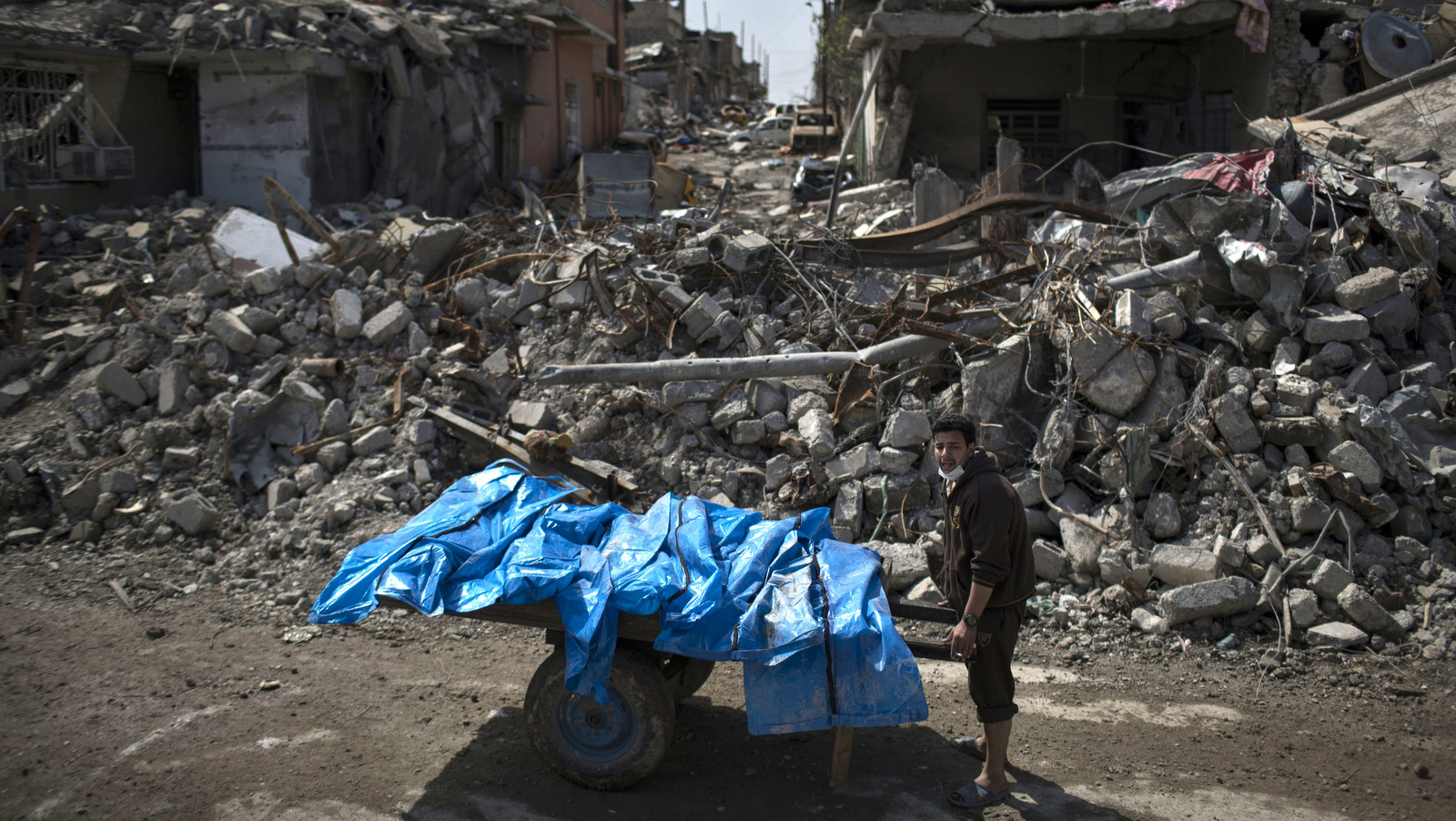
Residents carry the body of several civilians killed in a US airstrike in Mosul, Iraq on March 24, 2017. Felipe Dana | AP
A nation that continues year after year to spend more money on military
defense than on programs of social uplift is approaching spiritual
death. -- Martin Luther King Jr.
And this was said in 1967. I think we have overshot the spiritual death runway.
"Writing in 2013, Schmidt and Cohen stated,
'What Lockheed Martin was to the twentieth century, technology and cyber-security companies will be to the twenty-first.'"
A curiously inflexible brand of race-first neoliberalism has taken root in American political discourse.
In order to legitimate what Michaels describes as “racial
rent-seeking,” a curiously inflexible brand of race-first neoliberalism
has taken root in American political discourse, proposing a trickle-down
model of racial progress, anchored in the mysticism of organic black
community. Against this exoticized backdrop, neoliberal race leaders
stage the beguiling fantasy that individual “entrepreneurialism” is the
key path to rising above one’s circumstances—i.e., the standard American
social myth that obscures the deeper need to combat systemic
inequalities. The most tragic, and pathetic, expressions of this faith
are the versions of the “gospel of prosperity,” which fuse pop
self-realization psychology and a barely recognizable Christianity to
exploit desperation and the desire for life with dignity and respect
among their black-majority congregations. The false hopes of the
prosperity gospel encourage already vulnerable people to fall prey to
all sorts of destructive get-rich-quick schemes; they are the “sigh of
the oppressed creature, the heart of a heartless world, and the soul of
soulless conditions” channeled through a market-idolatrous Protestant
psychobabble. Black ministers and other proponents of entrepreneurialist
ideology as racial uplift also played a largely unrecognized role in
pushing subprime mortgages, and even payday loans, in black communities.
The racial trickle-down success myth is partly a vestige of an
earlier era, during which individual black attainments could be seen as
testaments to the race’s capacities—and a refutation of the
white-sanctioned view of black people as generally inferior. Even then,
however, this model of black uplift was enmeshed in the race theory of
the time—notably the belief that a race’s capacities were indicated by
the accomplishments of its “best” individuals—and it was always
inflected with the class perspectives of those who saw themselves as
such individuals. The class legacies of this foundational moment in
modern black politics may well contribute to the firm insistence among
today’s “black voices” that slavery and Jim Crow mark the transcendent
truth of black Americans’ experience in the United States—and that an
irreducible racism is the source of all manifest racial inequality. That
diagnosis certainly masks class asymmetries among black Americans’
circumstances as well as in the remedies proposed to improve them.
Nevertheless, we continue to indulge the politically wrong-headed,
counterproductive, and even reactionary features of the “representative
black voice” industry in whatever remains of our contemporary public
sphere. And we never reckon with the truly disturbing presumption that
any black person who can gain access to the public microphone and
performs familiar rituals of “blackness” should be recognized as
expressing significant racial truths and deserves our attention. This
presumption rests on the unexamined premise that blacks share a common,
singular mind that is at once radically unknowable to non-blacks and
readily downloaded by any random individual setting up shop as a racial
voice. And despite what all of our age’s many heroic narratives of
individualist race-first triumph may suggest to the casual viewer, that premise is the essence of racism.
Adolph Reed is a professor of political science at the University of Pennsylvania
AJP: You do Palestine organizing in New Mexico. How did you get involved in being a Palestine solidarity organizer?
Jeffrey Haas
JH: It was a natural development because the
Panthers talked about human rights and equal rights and so when you’re
open to that, you really don’t want to accept injustice anywhere. I had
grown up in a reform Jewish congregation in Atlanta that wasn’t
particularly Zionist, but we had heard all the myths about “if we give
money, we’re planting trees to make the desert bloom,” not to hide what
had been done to Palestinian villages. As I and many others took up the
liberation struggles of Central Americans fighting for liberation, the
issue of Palestine came up directly when we learned about what was
happening in Guatemala. The corrupt junta was killing and putting masses
of indigenous people in internment camps aided directly by the state of
Israel. Why was Israel doing the dirty work of the US? Why did Israel
continue to support the apartheid government in South Africa to the very
end? It became clear that Israel was an apartheid state itself and had
not only sided with other authoritarian colonial oppressors, but sought
to benefit financially by selling the surveillance and military
technology they used to repress the Palestinian people to other colonial
and imperialist powers.
With the first attacks on Gaza in 2014, I helped organize a group
called Another Jewish Voice of Santa Fe. There was also Another Jewish
Voice of Albuquerque and we joined together. We continue to organize and
raise issues, to protest as Santa Feans For Justice in Palestine. We
put up some very explicit artwork on a very public wall depicting
Israeli atrocities to Palestinian youth a year ago and raised a lot of
awareness . . . and not unsurprisingly got some Zionist backlash. We
worked closely with the Red Nation because they are frequently drawing
the connection between the struggles of Native Americans and the
struggles of Palestinians against colonialism. A lot of the techniques,
military gear and devices that Israel uses against Palestinians have
been taught to and acquired by US law enforcement and used against the
Black movement in Ferguson and the indigenous-led Water Protectors at
Standing Rock.
"The announced purpose of the 'maximum pressure' campaign – to change the Government of Venezuela – violates the principle of sovereign equality of states..."
President Joe Biden's administration plans to continue to seek to extradite WikiLeaks founder Julian Assange from the United Kingdom to the United States to face hacking conspiracy charges, the U.S. Justice Department said.
The Sun is all the colours mixed together, this appears white to our eyes.
The Sun is composed of hydrogen (70%) and Helium (28%).
The Sun is a main-sequence G2V star (or Yellow Dwarf).
The Sun is 109 times wider than the Earth and 330,000 times as massive.
The Sun’s surface area is 11,990 times that of the Earth’s.
The distance between the Earth and the Sun is an Astronomical Unit (AU)
One million Earths could fit inside the Sun. A
hollow Sun would fit around 960,000 spherical Earths. If squished
inside with no wasted space, then around 1,300,000 would fit inside. The
Sun’s surface area is 11,990 times that of the Earth’s.
The Sun contains 99.86% of the mass in the Solar System. The
mass of the Sun is approximately 330,000 times greater than that of
Earth. It is almost three quarters Hydrogen, whilst most of the
remaining mass is Helium.
The Sun is an almost perfect sphere. There
is a 10-kilometre difference between the Sun’s polar and equatorial
diameter. This means it is the closest thing to a perfect sphere that
has been observed in nature.
The Sun will consume the Earth. When
the Sun has burned all its Hydrogen, it will continue to burn helium
for 130 million more years. During this time, it will expand to the
point that it will engulf Mercury, Venus, and the Earth. At this stage
it will have become a red giant
The Sun will one day be about the size of Earth. After
its red giant phase, the Sun will collapse. It will keep its enormous
mass with the approximate volume of our planet. When this happens, it
will have become a white dwarf.
The temperature inside the Sun can reach 15 million degrees Celsius. Energy
is generated at the Sun’s core, by nuclear fusion, as Hydrogen converts
to Helium. Hot objects expand, the Sun would explode if it were not for
its enormous gravitational force. The temperature on the surface of the
Sun is closer to 5,600 degrees Celsius.
Light from the Sun takes eight minutes to reach Earth. The
Sun is an average distance of 150 million kilometres from the Earth.
Light travels at 300,000 kilometres per second. Dividing one by the
other gives us an approximate time of 500 seconds (or eight minutes and
20 seconds). Although this energy reaches Earth in a few minutes, it
will already have taken millions of years to travel from the Sun’s core
to its surface.
The Sun travels at 220 kilometres per second. The
Sun is 24,000-26,000 light years from the galactic centre. It takes the
Sun 225-250 million years to complete an orbit of the centre of the Milky Way.
The distance from the Sun to Earth changes throughout the year. This
is because the Earth travels on an elliptical orbit around the Sun. The
distance between the two bodies varies from 147 to 152 million
kilometres.
The Sun is middle-aged. At
around 4.6 billion years old, the Sun has already burned off about half
of its store of Hydrogen. It has enough left to continue to burn
Hydrogen for approximately 5 billion years. The Sun is currently a type
of star known as a Yellow Dwarf.
The Sun has a very strong magnetic field. Magnetic
energy released by the Sun during magnetic storms causes solar flares.
We see these as sunspots. In sunspots, the magnetic lines twist and they
spin, much like a tornado would on Earth.
The Sun generates solar wind. The
wind is a stream of charged particles. This travels at approximately
450 kilometres per second through the solar system. Solar wind occurs
when the magnetic field of the Sun extends into space.
Sol is the Latin for Sun This
is where the word “solar” comes from, which is used to describe things
that are derived from, related to, or caused by the Sun
This is sweet and lovely in the purity of its boot-licking authoritarianism:
BELOW IS A RECREATION OF A TWEET: Repeat after me:
I am not smarter than Joe Biden.
I am not smarter than Kamala Harris.
I am not smarter than Nancy Pelosi.
I am not smarter than James Carville.
But if I l stand back and watch and learn,
I will be smarter than I am.
The authoritarian personality is
simple: it slurps up; kicks down. You know the type. You’ve seen them
wherever you’ve worked, and you loathe them.
What is true is that Biden, Harris and
Pelosi people are good at politics. They are good at seeking and
getting political office.
But this is a category error; a profoundly stupid and harmful one.
First, this says nothing about their
intelligence. Trump became President, is he smarter than you? (Or, if
you’re dumb, smarter than many philosophers, scientists and so on who
never earn any political office?)
What about George Bush Jr. smarter than you?
These people are good at getting
political office, that doesn’t mean they are good at anything else.
Pelosi is good at raising money and intra-caucus politics, but the House
Democrats haven’t had a great electoral record while lead by her. She
also passed almost all of Trump’s bills, including terrible ones like
massive tax cuts and so on. She has renewed the Patriot Act multiple
times. She refused to reign in George Bush when she got a majority in
2006.
She may be a good politician, but so what?
Harris did terribly in the primaries.
She attacked Joe Biden as a segregationist (he was) and earned the VP
slot, as best I can tell, by a campaign of backstabbing all the other
possible candidates. She helped keep people known to be innocent in
prison when a prosecutor.
Biden, in addition to being a
segregationist, was one of the main Democratic boosters of the Iraq war.
He was a driving force behind the bankruptcy bill which made it
impossible to to discharge student debt. The Patriot Act was based on a
bill he tried to pass in the 90s. He threatened Cuba with devastation if
they dared give Snowden asylum. He’s apparently a great boss and a
loving family man, but he’s filth. He’s also a known plagiarist.
Being able to get political
power implies nothing more than an ability to get political power.
Becoming rich implies nothing more than an ability to become rich.
Being good at A does not mean you are good at B to Z.
It certainly doesn’t mean your getting
political power or money is good for anyone else. In most cases, the
rise of most billionaires has been bad for other people. They have made
money because they found a way to impoverish other people. Of course,
there are exceptions, but they are exceptions.
Grow some self-respect and a spine. Your leaders are only better than you in one sense: they are better predators than you are.
“Oh, I so admire the wolf,” simpered the sheep.
In fact, much of why you aren’t them
is because you have morals. You aren’t willing to lock up people who
know are innocent, like Kamala. You aren’t willing to destroy a foreign
country and kill a million people like Biden. You wouldn’t go along with
Trump’s massive tax cuts like Pelosi.
You have some ethics; some morality.
You wouldn’t run a huge scheme to defraud millions of people and/or
steal their homes like almost everyone senior on Wall Street. There are
limits on the evil you are willing to do for money or power, and that
means, in America, you can’t have either.
Whenever someone who has ethics gets
anywhere near power, (Corbyn or Sanders) everything possible is done to
destroy them. The media lied over 75% about Corbyn. Every single
candidate dropped out in a period of a day to deny Sanders the
Democratic nomination; an effort coordinated by Obama (who may well be
smarter than you, and whose evil was carefully concealed behind his
smiling sociopathy.)
The elites have spent the last 50 or
so years driving 97% of Americans into the dirt, and rewarding
themselves with billions. They are predators, and nothing else. You are
the sheep, and the cops and military are the sheepdogs: still animals,
and discarded the moment they aren’t useful. (Check those military
veteran homeless stats.)
Biden, Harris and Pelosi (who cares
about Carville?) aren’t smarter than you, odds are, and unless you’re
Stalin reborn, they’re worse people than you in every way except their
ability to get and hold power and use it against the American people and
foreigners.
Hopefully they’ll be less evil rulers than Trump (though note, he didn’t start any new wars), but that’s not a bar.
Have some self respect. Your system elects not the best of you, but the worst.
Thinking the worst are the best:
that’s the problem. They’ve indoctrinated you like farm animals “they
feed us, and I’m sure the beating are because they love us, and I’m sure
when they loaded Thelma and Fred and George on the truck last week and
they never came back, well they were taking them to a better place.”
Except you don’t even get that good a deal, since they’re happy to see you starve and don’t try and heal you when you’re sick.
Grow up.
These people feed on you, and that’s all you are to them.
And yet, Democratic lawmakers are also considering a new tax break
that could cost nearly as much or more as the savings gleaned from
reducing the survival checks — and the tax break’s benefits would
primarily go to the rich.
At the same time, there is a palpable relief that Donald Trump’s four years of policy improvisation, emotional instability, and outbursts of racial and gender animosity are now coming to a close. The idea that a person of Trump’s impulsiveness and shallowness had a hand in US foreign and military policy would keep any sane person awake at night. Sadly, it escapes most pundits’ and politicians’ short memory that previous Presidents, like Nixon, Reagan, and Bush, were equally, if not more, dangerous.
Where Trump’s self-delusion as a master in dealmaking led him to seek rapprochement with some of the establishment’s designated enemies, he was invariably thwarted by the establishment’s fail-safe mechanisms. If the four years of Trump taught us nothing, it was that the rules of the game were carefully protected by the mechanisms long established by the capitalist ruling class to contain politics within a narrow range of action. Trump’s unorthodox policies ran headlong into the firewall created by what Marx described as the “...committee for managing the common affairs of the whole bourgeoisie.” They were stalled, ignored, or subverted by the system’s defenders.
Four years ago, before the 2016 inauguration, James Comey of the FBI-- representing the capitalist Praetorian guard, the security agencies-- advised Trump that his behavior was and would be carefully scrutinized. He was to understand, as other newly elected Presidents had customarily learned from J. Edgar Hoover, that embarrassing information could be produced to discredit his tenure. The infamous Steele Dossier was meant to demonstrate the power of the Praetorian Guard, should Trump get out of line. Through sheer arrogance or ignorance, Trump defied the message and fired the messenger. Consequently, he battled the security services throughout his Presidency.
Too often the center-left, the decaffeinated left, sided with the snoops, torturers, and killers of the security services in their ruthless campaign to get Trump-- a dangerous game of opportunism that surrenders the few remaining restraints on the police and judicial system. Those who can protect us from Trump will protect us from real social change with even more zeal.
British Judge Vanessa Baraitser has ruled against US extradition for WikiLeaks founder Julian Assange, but not for the reasons she should have. Baraitser's frightening ruling supported virtually every US prosecutorial argument that was made during the extradition trial, no matter how absurd and Orwellian.
In
accordance with a British magistrate court’s usual procedure, Julian
Assange’s Judgment has almost certainly already been written and sent in
draft form to the respective teams of lawyers, probably early on Friday
evening.
The
lawyers therefore already know what the decision is, as well as the
British government and at least the Department of Justice in Washington.
Under established procedure,
Assange’s lawyers are not supposed to tell Assange himself what the
decision is so he and his family are probably the only people who are
directly involved in his case who don’t yet know its outcome.
The
purpose in sending the Judgment in draft form to the lawyers in advance
of the Court hearing is to give them an opportunity to check it for
factual mistakes.
The
public will not know the outcome until Magistrate Vanessa Baraitser
reads out the Judgment in its finalised form, with any factual mistakes
corrected, when Court convenes on Monday at 10 am London time. The
Judgment should then be published online by the Court Service directly
after she has finished.
In
addition to the Judgment – and obviously to the decision whether or not
to extradite, which will be set out in the Judgment – the public may
learn immediately afterward whether either of the two sets of lawyers
intend to appeal. Either side has seven days to appeal the judgment.
While
the intent of allowing both sides to see the Judgment in advance is not
to help facilitate an appeal, having the judgement before it is read to
the court affords attorneys to a chance to consider whether or not to
launch one.
If It’s a Split Decision
One
possibility that must be considered is that Baraitser may decide to
extradite on one indictment and not on the other, for instance, if she
rules against extradition on the Espionage Act charges, but decides in
favour of extradition on the conspiracy to commit computer intrusion
charge (which carries a maximum five year sentence as opposed to 170 on
espionage.)
I
think what would happen in that case is that the British authorities
would accept Baraitser’s decision and would try to reach an agreement
with the DoJ whereby, in return for Assange’s extradition, the U.S.
would commit itself to try Assange only on the computer intrusion
charges, and not on the Espionage Act charges.
The
British over the course of the negotiations would tell the U.S. that if
the U.S. were not willing to give that commitment then the British
would not be able to extradite Assange to the U.S.
Of
course the British (if Assange were extradited to the U.S. on such a
basis) would be in no position to compel the U.S. to abide by such a
commitment if the U..S were to go back on it once Assange was on U.S.
soil.
Since
that has to be a very likely possibility, one would think it would be a
point which Assange’s lawyers would make in the appeal they would be
bound to make to the High Court against Baraitser’s decision.
In fact in such a scenario it’s not impossible that both sides would appeal to the High Court:
(1) the U.S. against Baraitser’s decision to refuse to extradite on the basis of the Espionage Act;
(2) Assange’s lawyers against Baraitser’s decision to extradite on the computer intrusion charges.
It would be a fascinating battle and it would be fascinating to see how it would play out.
Logically,
the balance ought to tip in Assange’s favour since Baraitser would
presumably have rejected extradition on the Espionage Act charges
because they were not properly made out and because they were overtly
political.
In
light of that, would the High Court be prepared to allow Assange’s
extradition on computer intrusion charges to a country which had tried
unsuccessfully to bring overtly political charges against him which the
lower Court had rejected?
Nothing is predictable in this case.
Appeal Scenarios
In
the event that Baraitser decides the case in Assange’s favour, and the
U.S. government decides to appeal, there is also the question of whether
or not Assange will be released pending the outcome of the appeal, or
whether he will continue to be kept in detention in Belmarsh.
Journalist Glenn Greenwald in his latest article assumes that Assange will remain in detention throughout the appeal process, but that is not certain.
Since
there would be a Court Judgment saying that extradition had been
refused, and since Assange is not being held because of any crime
committed in the United Kingdom, and as there is no outstanding prison
sentence imposed on him by any British Court, one would think that
Baraitser in her Judgment would order his immediate release.
British
authorities might take steps to rearrest him (perhaps on still more,
new U.S. charges) immediately as the order for his release is made. But
it seems certain that Assange’s lawyers would make an prompt
application, either to Baraitser or to a High Court judge for Assange’s
immediate release, which given a hypothetical decision in his favour,
Baraitser or the High Court judge would probably grant.
Given
Baraitser’s demeanour in court during Assange’s hearing, and given
several of the decisions she made, the greater likelihood is that she
will rule in favour of U.S. extradition on both indictmments, in which
case Assange would almost certainly remain in Belmarsh prison while his
legal team appeals. If she should pursue a split decision
there would be a stronger likelihood that Assange would continue in
detention until the appeal were decided because the Court would have
decided to allow his extradition to the U.S.
However
even in that case Assange’s lawyers would still be in a position to
apply for bail on the grounds that the most serious and important part
of the case made by the U.S. for his extradition (the Espionage Act
charges) had been refused, and that his appeal against the remaining
part (the computer intrusion charges) was likely to be successful.
The public and Assange himself will know in less than 48 hours.
Alexander Mercouris is a political commentator and editor of The Duran.
In the voluminous writings he composed during his eleven years
imprisonment under the fascist regime, Antonio Gramsci repeatedly cites
the aphorism, “pessimism of the intellect, optimism of the will” (which
he ascribed to the novelist Romain Rolland). In one of his letters, he
expanded the idea: “The challenge of modernity is to live without
illusions and without becoming disillusioned … I’m a pessimist because
of intelligence, but an optimist because of will.” In the context of
Gramsci’s life and work, the phrase had a particular resonance. He was
suffering isolation and deprivation in prison, from which he had no hope
of release. The left, and with it, for Gramsci, the prospects for
humanity, had suffered terrible reverses. In these conditions the
aphorism was a formula for survival. It also has to be seen in relation
to the major concerns of his prison writings: the connection between
theory and practise, the role of intellectuals, the dialectic of
subjective and objective factors.
The phrase has long appealed to activists, who recognise in it
something true to their own experience and find it sustaining. It’s a
powerful warning against wishful thinking, like Amilcar Cabral’s command
to “Mask no difficulties, mistakes, failures. Claim no easy victories.”
And at the same time it’s a counsel against resignation. It proposes a
determined, open-eyed engagement with history, something we’d all aspire
to.
But presented baldly as it often is, as a complete answer to a
persistent question, I’ve found it increasingly problematic. I’m not
sure that either “will” or “intellect”, “optimism” or “pessimism”
represent the realities of our situation, or are categories that can do
the work the aphorism assigns to them.
Left activism surely calls for a relationship between “intellect” and
“will”, not their separation into opposing camps. In any case, they
never exist independently of each other and at times can infect and
distort each other. I think everyone on the left knows that an unbending
optimism of the will can corrupt or compromise intellectual clarity.
And no one should pretend that relentless pessimism of the intellect is
not debilitating.
“Optimism of the will”, as a duty, turns us into divided people. It’s
one of those impossible, unreal injunctions, like “live every day to
the fullest” or “always look at the glass half full instead of
half-empty”. It’s a recipe for denial, with all the neuroses that
accompany it. If optimism is made compulsory the danger is it becomes
compulsive. It breeds a voluntarism that is compelled to exclude
unwelcome thoughts or feelings.
Where is the logic of optimism if there are no rational grounds for
it? If there really is no chance of effecting change, then why bother
with activism? Is it self-vindicating, something pursued for its own
sake, or is it goal-orientated? We’re often reassured that “the process”
is what matters. And yet essential to that process is “keeping your
eyes on the prize”. How is that possible if you’ve decided the prize is
an illusion?
And what is “will”? It’s not passion or emotion but is clearly
grounded in them. It’s presented as a faculty of consciousness, as
consciousness imposing itself over habit or environment, as a mastery of
self and circumstances. But can “will” ever be entirely an entity of
consciousness? Its sources lie in the sub-conscious. And in reality, as
any therapist will tell you, “will power” or “mastering the self”
requires recognition of precisely that sub-conscious grounding, and
indeed of the illusions of “mastery” and “will”.
Pessimism of the intellect, as a principle, can be as distortive in
its way as wishful thinking. It is as irrational to deny possibilities,
to foreclose developments, as it is to imagine they exist where they do
not. There is of course the pessimism of the intellect of the right,
which discounts human capacities and sees capitalism as the end of
history. That is most definitely not what Gramsci was talking about. But
on the left, pessimism of the intellect sometimes takes on a
pseudo-authority, it becomes exactly what Gramsci warned against, a form
of self-protective “disillusionment”, that preserves itself and its
authority by not investing in immediate or medium term hopes.
Over the years, in the wake of defeats or disappointments, I’ve been
told by “wise men” of the left that of course it was inevitable. With
professorial condescension, they’ve informed me that given the balance
of forces, etc. it could have only worked out this way and it was naive
to think otherwise. These days I see that posture as a defence
mechanism, a way of denying pain or despair or frustration – and
sometimes a way of imposing a personal superiority by claiming to embody
objectivity and historical acuity. To make hope real, to exercise an
optimism of the will, you have to invest in it: your time, your energy,
your sense of self and your role in the world. Without that, movements
cannot move.
In light of these considerations, how does the aphorism apply to our
current situation? Looking to the future, there seem extensive grounds
for pessimism. It’s more than possible that capitalism will resolve its
current crisis at the expense of the working class and to its own
historic advantage. It will unburden itself of past compromises. Levels
of social support of all kinds will be reduced. Much of the workforce
will be casualised and outsourced. Struggles for social justice will
then have to be waged from the lower, weaker ground created by these
defeats. In Britain, the NHS will be dismantled and not reassembled by a
future Labour government.
Meanwhile, the hopes of the Arab Spring have been blighted by
imperial and sectarian violence. Climate change continues unchecked, as
recent news of the accelerating retreat of the Arctic icecap shows,
while governments nearly everywhere downgrade the issue and shrug off
responsibility. Global crises in both water and food supply are said to
be imminent, the result of the pressure of capitalist priorities.
Altogether it’s a dismal prospect. It seems all we can hope for is the
dubious pleasure of being able to say “we told you so”.
Yet none of this is cast in stone. Probabilities are never
certainties. The odds can alter with astonishing speed, depending on the
shifting conjunction of variables – among them our own actions, our
“will”.
There are other sides of the story, notably in Latin America, where
inroads have been made on neo-liberalism with significant benefits for
the poor. In Europe, levels of resistance may well rise, including here
in Britain, where we’ve only begun to feel the brunt of the cuts. As
austerity is seen to fail, more people will seek an alternative. As for
the Arab Spring, it is of course far too early to tell. The popular
aspirations that entered the political arena, that opened up that arena,
are still working themselves out, subject to intense pressures from
various directions. The democratic revolutions in Europe of 1848 were
mostly unsuccessful or rolled back or co-opted. Nonetheless, the year
did mark a leap forward, one which was the indispensable condition for
the progress that eventually did take place.
It’s only in our own time that capitalism has fulfilled the destiny
Marx ascribed to it, becoming a truly global system and subjecting an
ever-wider range of social relations to its imperatives. But at this
moment of climax it has imploded. Even as it reaches its global apogee
and maximises its penetration, capitalism stands exposed as crisis-prone
and anti-social. It no longer even offers the prospects for individual
social mobility that have won it such allegiance in the past.
The important break-through of the last few years has been the spread
of a critical view of capitalism – a system which for many years we
weren’t even allowed to name (as it masked itself behind euphemisms like
“the market” or “free enterprise”). It might be said that we have
learned to name the system, but not its alternative. As Gramsci said in
his Prison Notebooks, “The crisis consists precisely in the fact that
the old is dying and the new cannot be born.”
Optimism of the will, the willingness to sacrifice for a larger goal,
has been made harder by the collapse of existing alternatives, both
Communist and social democratic, as well as by the retreat of liberalism
into a capitalist ‘realism’. Utopianism in general, as a mode of
thinking, has been banished from mainstream discussion. In this
situation we need a kind of ‘optimism of the intellect’: a determined
search for the levers of change in the here and now, coupled with the
imagining of a just and sustainable society, a better human future,
which is a necessary prelude to making that future a concrete
possibility.
Our hopes lie in the unresolved nature of the present. Life is fluid
and contradictory. Any moment contains multiple possibilities, which in
turn generate further possibilities. We do not and cannot fully know the
whole that is currently evolving, and we have no right to foreclose the
future. Had that been done by the radicals of the past – abolitionists,
feminists, trades unionists, democrats – we wouldn’t even be talking
now. As Blake said, “the ratio of all we know will be different when we
know more.” Blanket injunctions either to pessimism or optimism deny the
inherently mixed, multi-stranded character of social reality.
The human faculty for cooperation, along with the unalterable facts
of human interdependency, remains a perennial source of hope (more
important I think than ‘optimism’). History attests to our capacity for
creativity and compassion as much as our capacity for destruction and
hate. The reality is that value is still created outside the mechanisms
of exchange, in relationships and in creative and cooperative acts of
all kinds. These are real – in some ways more real than the exchange
value worshipped by capitalism – and they permeate our lives and nourish
us.
I ask myself how Palestinians address the pessimism / optimism
equation. They face as grim a present and as unpromising a future as
anyone on the planet. Their long struggle for freedom is for the moment a
struggle for survival – against a ruthless opponent backed by the
world’s superpower, encumbered with a corrupt and ineffectual official
leadership, under daily political, economic and environmental attack. In
a way, Palestinians have been living with this for years. Much of
Palestinian literature is a record of a struggle against despair and
dissolution. Despite everything, they have held to their aspirations,
sustaining not just an ‘identity’ but a political project. Their
injunction is “Samoud” – steadfastness. Here the present is a moment of
duty to past and future, a link between the two. This is an approach we
can emulate, remaining “steadfast” in our opposition to the current
regime and in our vision of a better future.
In a sense, pessimism of the intellect is always in order because we
are up against titanic forces, whose powers, reach, resources dwarf our
own. The only things we can match them in are motivation, determination
and imagination. Radical politics always involves redefining the
possible, freeing it from the circumscription of received ideas. Today
that means rejecting the faux-realism which construes the imperatives of
capital as supra-human law. It means replacing capitalism’s hubristic
claim to be ‘the end of history’ with a revival of Marx’s idea that only
with its abolition will we see the beginnings of a truly human history.
Without doubt, what we do or don’t do now will shape what others are
able to do in the future. In calculating the odds of success, remember
Archimedes on the power of the lever: “Give me a place to stand on, and I
will move the Earth.”