SIRATYST (Stuff I Read and Thought You Should Too) --
“To ravage, to slaughter, to usurp under false titles, they call empire; and where they make a desert, they call it peace.”
(Calgacus, as quoted by Tacitus, Agricola 30-31)"
"Fascism seems to have risen up zombie-like from the past, but
philosopher and political theorist Gabriel Rockhill argues that it's
been with us all along.
Today on the show, Allen traces a
counter-history of fascism—including its relationships to liberalism,
capitalism, and colonialism and how we understand/misunderstand its role
in the U.S.—with Gabriel Rockhill.
Gabriel Rockhill is a
professor of philosophy at Villanova University and the founding
director of the Critical Theory Workshop (Atelier de Théorie Critique).
He is the author or editor of nine books, including Radical History and
the Politics of Art (Columbia University Press, 2014), Interventions in
Contemporary Thought: History, Politics, Aesthetics (Edinburgh
University Press, 2016), Counter-History of the Present: Untimely
Interrogations into Globalization, Technology, Democracy (Duke
University Press, 2017). He recently published a series of articles
about fascism in Counterpunch and Black Agenda Report."
Excerpt (as an independent Marxist, I found this essay very inspiring):
Dixi et salvavi animam meam. With these Latin words Karl Marx concludes his Critique of the Gotha Program (1875) – “I have spoken and saved my soul.” One is unaccustomed to religious expression from the great communist, unless it be sarcastic, yet here he uses it to conclude a devastating analysis of the program of German workers party. What is Marx’s soul? How did he save it? And what about ours?
"If Biden has, in fact, received so
many more votes, why is the CNN-led media flock in such a hurry to
declare him the winner? Is it the media’s job to decide the winner in a
democracy? How will Trump and his sympathisers, about half of the people, react to what they must see as a provocation?
Why is Biden also offering no hope for the US itself and the world? How to explain this utterly strange happening and where will the US be in January 2021?
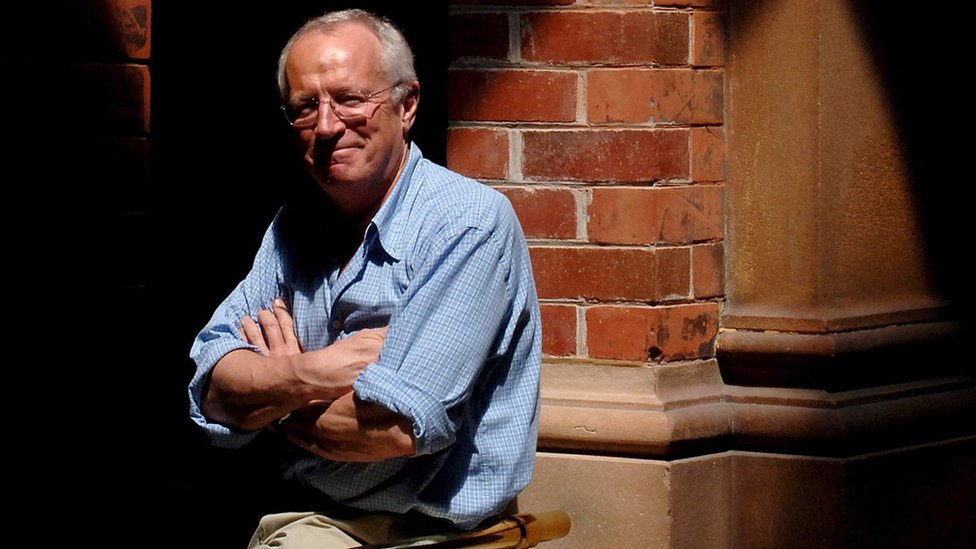
Robert Fisk was best known for his coverage of the Middle East, where he began reporting from in the 1970s
Veteran foreign correspondent Robert Fisk has died of a suspected stroke at the age of 74.
He
had been admitted to St Vincent's Hospital in Dublin after falling ill
at his home on Friday, and died shortly afterwards, the Irish Times
reported.
Fisk won numerous awards for his reporting on the Middle East, starting from the 1970s.
But he also drew controversy for his sharp criticism of the US and Israel, and of Western foreign policy.
Covering wars in the Balkans, Middle East and North Africa for UK newspapers over five decades, Fisk was described by the New York Times, in 2005, as "probably the most famous foreign correspondent in Britain".
Born in Maidstone, Kent in 1946, he later took Irish citizenship and had a home in Dalkey outside the capital Dublin.
Irish President Michael D Higgins has expressed his "great sadness" about Fisk's death on Sunday.
"With his passing the world of journalism and informed commentary on the Middle East has lost one of its finest commentators," he said in a statement.
After
starting his career at the Sunday Express, Fisk moved to Belfast in
1972 to cover the Troubles as Northern Ireland correspondent for the
Times. He became the paper's Middle East correspondent in 1976.
Based
in Beirut, he reported on the civil war in Lebanon, as well as the
Iranian Revolution in 1979, the Soviet war in Afghanistan and the
Iran-Iraq War.
He
resigned from the Times in 1989 after a dispute with the owner Rupert
Murdoch and moved to the Independent, where he worked for the remainder
of his career.
In
the 1990s he interviewed Osama Bin Laden three times for the paper. He
described him as a "shy man" and looking "every inch the mountain
warrior of mujahedin legend" in their first interview in 1993.
'Gutsy and admired'
Robert
Fisk was brave and controversial. He was a brilliant writer, who did
his best work in wars, transporting readers to his side in some burning
village. He relished making enemies, especially if they defended US or
Israeli activities in the Middle East.
Fisk
could be obsessive. He collected bits of shrapnel, often American made
and fired by Israel, so he could use serial numbers to trace their
origins.
When
I visited Beirut from Jerusalem in the 1990s he served me gin and
tonics on his balcony overlooking the Mediterranean in a Yasser Arafat
souvenir glass. Robert was old school. He poked fun at the flak jacket I
brought to Lebanon from the former Yugoslavia, sniffing it to check for
slivovitza plum brandy.
Journalism
can be a dog-eat-dog trade. Fisk's colleagues were not always kind
about his work. I was an admirer, eating up his vivid reportage from
Beirut when I was at school, and was awestruck when first I met him.
I'll miss Robert, his guts and his appetite for the fight, even though
usually he followed a warm hello with some crack about the evils of
television news or the BBC.
After
the 11 September attacks plotted by Bin Laden, Fisk, an Arabic speaker,
spent the next two decades covering conflicts throughout the Middle
East, including in Afghanistan, Iraq and Syria.
He
was highly regarded for his knowledge of, and deep experience in, the
region, and often dismissed journalists who sat behind desks instead of
venturing out into the field.
But
he also drew criticism for his attacks on Western policy in the Middle
East and was accused of being lenient towards the Syrian government in
his reporting of the country's long and brutal civil war.
Articles
by Fisk about the US and Israel were often considered highly
controversial. He said the Trump administration's acceptance in 2019 of
Israel's annexation of the occupied Syrian Golan Heights showed Israel had effectively annexed the US, and repeatedly accused Israel of committing war crimes against the Palestinians.
In 2011 Fisk was forced to apologise
after the Independent was successfully sued by the then-Saudi interior
minister over a report that alleged the minister had ordered police to
shoot and kill unarmed protesters, based on a document which turned out
to be fake.
Fisk married US journalist Lara Marlowe in 1994 but the pair divorced in 2006. He had no children.
The good news is that this can be done while at the same time
accomplishing our goals of ending poverty and improving human
well-being. Indeed, this is the core principle of degrowth. Recent
research has found that we can ensure good lives for all – for a global
population of 10 billion people by 2050 – with 60 per cent less energy than we presently use. Another study found that high-income nations could cut their material use by up to 80 per cent, while still providing for everyone’s needs at a high standard.
How do we get there? Scale down ecologically destructive and socially
less necessary production (SUVs, McMansions, industrial beef, food
waste, planned obsolescence, advertising, etc); shorten the working week
and introduce a public job guarantee, with a living wage, to maintain
full employment and mobilize labour for the transition; decommodify
public goods, disaccumulate capital, and distribute income more fairly.
All of these policies have significant public support. I describe
feasible pathways toward this end in Chapter 5 of Less is More (or see here for
a post-Keynesian approach). Doing this would enable us to accomplish a
rapid transition to renewables, in a matter of years, not decades.
In other words, we cannot reverse ecological breakdown while at the same time pursuing growth; but we can reverse
ecological breakdown while at the same time ensuring flourishing lives
for all. That’s the story we need to be telling. That is where hope
lies.